
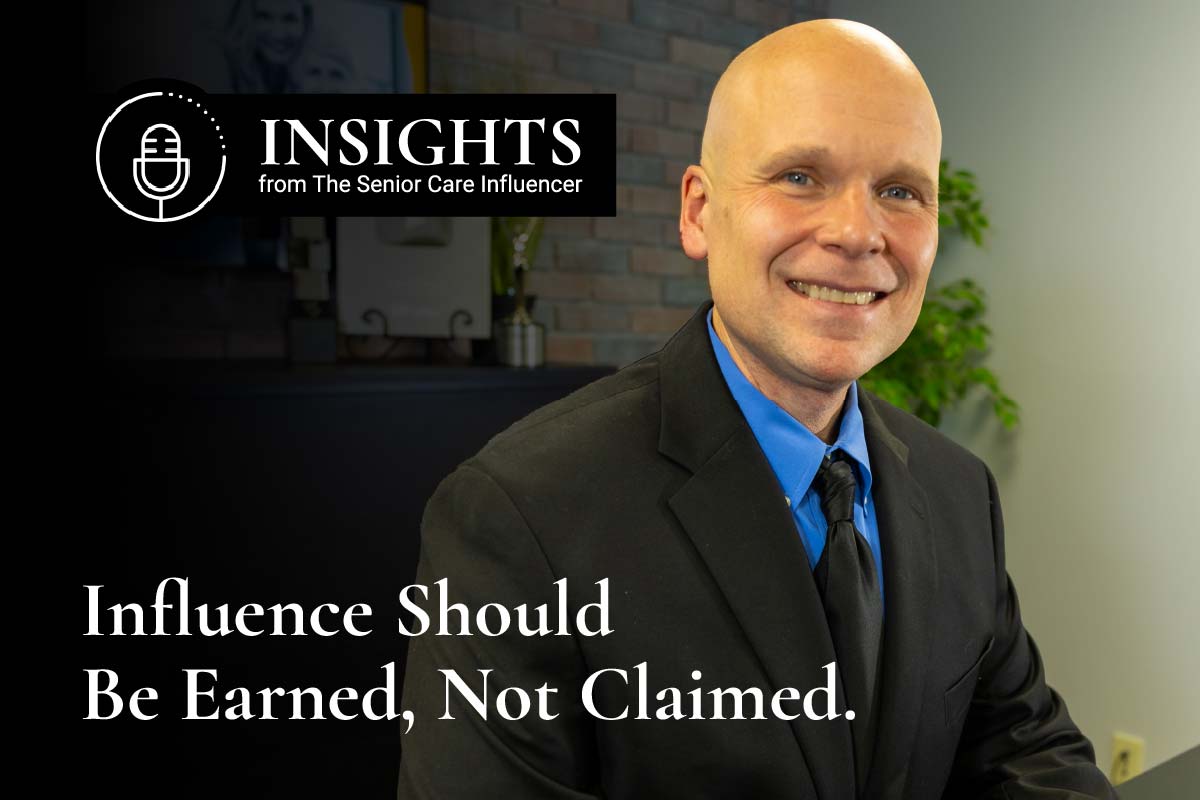
Influence is a word that is used often, but not always carefully.
In many spaces, influence is measured by attention. Followers, views, downloads, likes, shares, media mentions, and public visibility can create the appearance of authority. Those numbers may show that a message is reaching people.
But in senior care, reach is not enough.
Senior care is not fashion, entertainment, or casual lifestyle advice. It involves families making decisions about safety, dignity, independence, health, memory loss, aging, finances, home care, long-term care, end-of-life planning, and the daily realities of supporting someone they love.
The stakes are deeply personal.
That is why influence in senior care should be earned, not claimed.
A person can claim a title. A company can purchase exposure. A platform can attract attention. A message can travel widely.
But trust cannot be declared into existence.
Trust has to be built.
It has to be protected.
It has to be earned again and again through the way a person communicates, the questions they ask, the standards they hold, the partnerships they accept, and the responsibility they show toward the people who are listening.
Visibility Is Not the Same as Credibility
Visibility can be valuable.
It can bring attention to important issues. It can help a caregiver discover a resource. It can introduce a family to an expert. It can give organizations a way to share meaningful work with people who need it.
But visibility alone does not prove credibility.
A highly visible message can still be incomplete. A polished campaign can still ignore the realities families face inside the home. A popular voice can still speak beyond its expertise. A product can be well-marketed and still fail to solve the problem it promises to address.
In senior care, credibility requires more than being seen.
It requires experience.
It requires transparency.
It requires consistency.
It requires the humility to say when an issue needs clinical, legal, financial, or professional guidance beyond what general education can provide.
Credibility also requires respect for the people receiving the message. Families should not be treated as audiences to be captured. They should be treated as people carrying real responsibilities.
When someone has visibility in senior care, the question should not be only, How many people are watching?
The better question is, What happens because they are watching?
Families Are Often Listening During Vulnerable Moments
Many families encounter senior-care information when they are already under stress.
They may be trying to understand a new diagnosis. They may be watching a parent decline. They may be coordinating care from a distance. They may be exhausted by the demands of caregiving. They may be facing financial pressure, sibling disagreements, medical uncertainty, or the fear of making the wrong decision.
During those moments, people are more than consumers.
They are sons, daughters, spouses, siblings, friends, caregivers, and older adults trying to protect dignity and quality of life.
This is why senior-care influence must be handled carefully.
An exaggerated claim can create false hope. A vague recommendation can create confusion. A promotional message disguised as education can weaken trust. A careless statement can make families feel guilty, inadequate, or more alone.
The people listening may not have the time or emotional bandwidth to separate every helpful resource from every incomplete message.
That reality creates responsibility for anyone with a platform.
Influence should reduce confusion, not add to it.
It should help families ask better questions, not pressure them into quick answers.
It should respect their vulnerability, not use it.
Earned Influence Is Built Through Consistency
Influence in senior care is not earned through one article, one interview, one partnership, one award, or one successful campaign.
It is earned through patterns.
Do the messages remain consistent when no one is watching?
Are partnerships approached with the same standards that are described publicly?
Are families given honest context, even when that context makes a message less simple?
Are limitations acknowledged?
Are older adults spoken about with dignity?
Are caregivers treated as people rather than statistics?
Are credible voices elevated, even when they are not the loudest voices?
Consistency is one of the clearest signs of earned influence.
People eventually learn whether a platform is guided by mission or by opportunity. They can sense when a voice exists to serve the audience and when the audience exists to serve the voice.
In senior care, that difference matters.
A trusted platform should not shift its standards based on convenience. It should not make one set of promises to families and another set of decisions behind the scenes. It should not use trust casually.
Influence is strengthened when people know the mission remains greater than the attention.
Experience Matters, but So Does Humility
Experience is important in senior care.
Years of professional work, caregiving experience, interviews, education, service, and exposure to different perspectives can help someone communicate with greater depth and understanding.
But experience should not create arrogance.
The longer someone works in senior care, the more they should recognize how much no single person can fully know.
Every family is different. Every older adult is different. Every diagnosis, home environment, support system, and decision carries its own realities. What works well for one person may not be appropriate for another.
That is why humility is essential to earned influence.
A responsible voice does not pretend to have every answer.
A responsible voice knows when to elevate a physician, social worker, attorney, nurse, researcher, home care professional, family caregiver, advocate, author, or older adult whose perspective is needed.
A responsible voice understands that influence is not weakened by sharing the platform.
It is strengthened.
The goal should not be to become the only voice people hear.
The goal should be to help people hear the voices that can genuinely help them.
Partnerships Should Be Held to a Higher Standard
Senior care partnerships require careful thought.
There are many companies, organizations, products, services, and platforms trying to reach older adults and family caregivers. Many are doing important work. Some are solving real problems. Some are helping families communicate, plan, manage care, reduce isolation, support memory care, improve safety, or make caregiving more manageable.
But a partnership in senior care should never be treated as a simple promotional exchange.
The audience has to matter.
The families have to matter.
The older adults have to matter.
Before a product, service, or organization is introduced to an audience, important questions should be asked.
Does this address a real need?
Is the value clear?
Is the communication honest?
Are limitations explained?
Would this be appropriate for the people it is trying to serve?
Does the organization understand the vulnerability of the audience?
A trusted platform does not exist to sell every message. It exists to evaluate what should be elevated and how it should be explained.
That is part of the responsibility that comes with influence.
Earned Influence Creates More Understanding
The most meaningful influence in senior care does not simply make someone more visible.
It makes the issues more understandable.
It helps a caregiver recognize that they are not alone. It helps an older adult feel respected. It helps a family understand the questions they need to ask. It helps professionals communicate in ways that families can actually use. It helps innovators design around real needs instead of assumptions. It helps organizations speak with more humanity.
Influence should create understanding.
It should create connection.
It should create confidence without pretending that care is easy.
It should also create space for difficult conversations.
Senior care includes grief, burnout, uncertainty, dignity, autonomy, safety, finances, family conflict, system failures, and moments of profound love. A trusted voice should be willing to speak honestly about those realities without reducing them to fear or sentiment.
Families do not need perfect answers from public voices.
They need guidance they can trust.
They need context that helps them think clearly.
They need communication that treats them with respect.
What I Believe Influence Should Mean
As Lance A. Slatton, The Senior Care Influencer, I believe influence in senior care should always be tied to responsibility.
It should be earned through service, not claimed through branding alone.
It should be demonstrated through consistency, not measured only through reach.
It should elevate credible voices, not simply draw attention back to itself.
It should help families become better informed, not more dependent on any one platform or personality.
My own understanding of influence was shaped by caregiving first. Before the media platforms, interviews, writing, partnerships, awards, and public recognition, there was the experience of watching my own family navigate care.
That experience changed my life.
It taught me that behind every discussion about aging, dementia, home care, healthcare, and long-term care are people trying to do the best they can with the information, resources, and support available to them.
Those people deserve to be served with honesty.
They deserve to know when something is educational, when something is opinion, and when something involves promotion.
They deserve voices that understand the difference between attention and trust.
The Standard Must Be Higher
Senior care deserves a higher standard for influence.
Not because every person with a platform must be perfect.
But because the people listening are often carrying real fear, real responsibility, and real love for someone who needs support.
The future of senior-care communication should not reward only the loudest voices. It should reward the voices that bring clarity, credibility, compassion, and accountability into the conversation.
Influence should be earned by helping people.
It should be earned by asking better questions.
It should be earned by protecting trust.
It should be earned by remembering that every message has the potential to affect a family’s choices.
In senior care, influence should never be treated as something someone simply claims.
It should be something they continue to prove through the way they serve.